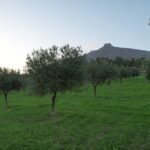
In Contrada Fico, in Valderice, you can hear autumn arrive. Voices between the rows, crates filling up, the wind rising from the sea towards Mount Erice. Between October and November we look after our 859 olive trees, on three hectares overlooking the Mediterranean. This is when a year of work becomes oil.
Here we tell you how we harvest, why freshly pressed oil has that colour and character, and how to treat it once it reaches your home.
Why we pick by hand
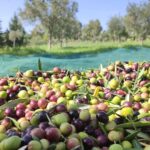
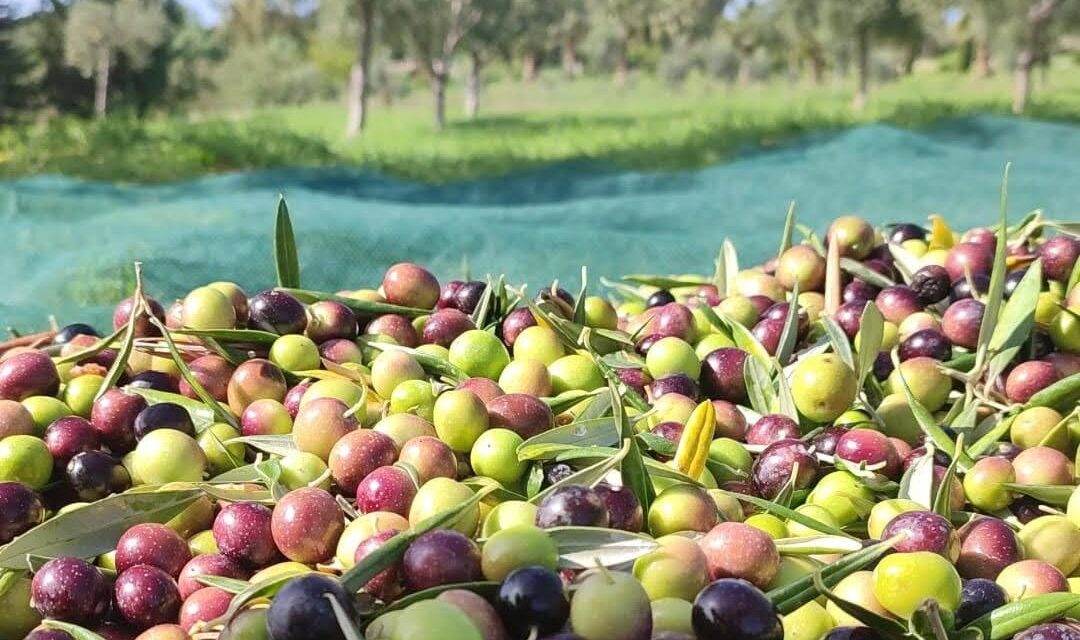
We harvest by hand, tree by tree. It is slower, we know. But it lets us look closely at every tree, choose the right moment for each row and handle the olives without crushing or bruising them.
A bruised olive starts to spoil straight away. If olives are left piled up for days, they can ferment and give the oil defects a taster spots at the first sip. That is why, once picked, the olives must reach the mill as soon as possible.
Polyconic vase pruning
The harvest starts months earlier, with pruning. Our trees are trained in a polyconic vase shape: the canopy is open in the centre and divides into several branches growing upwards. Light and air reach the inside of the tree, the olives ripen more evenly and they are easier to reach by hand at harvest time.
Just water, soil and sun
Our motto is “Just water, soil and sun”. In practice it means natural fertilisation and no synthetic chemicals in the grove. We let the character of the oil come from the soil of Contrada Fico, the winter rain and the long Sicilian summer sun.
From olive to oil: cold extraction, no filtering
Our Biancolilla and Nocellara olives are cold extracted, at a controlled temperature below 27 °C. Heat would yield more oil, but it would take away aroma and freshness.
Our oil is not filtered. That is why, especially in the first weeks, it can look slightly cloudy. Over time a small deposit may form at the bottom of the bottle: this is normal and comes from tiny particles of olive pulp.
Why new olive oil is green, bitter and peppery
People tasting freshly pressed oil for the first time are often surprised. It is neither sweet nor “neutral”. Here is why.
The green colour
The intense green comes mainly from the pigments of olives picked early, before they are fully ripe. Over the following months the colour softens towards yellow-green. But colour alone says nothing about quality: professional tasters even use blue glasses so as not to be influenced by it.
Bitterness and pepperiness
Bitterness is felt on the tongue. Pepperiness is a tingle that comes a moment later, in the throat, and sometimes makes you cough. The International Olive Council considers both positive attributes: bitterness is typical of oils from green or just-ripening olives, pepperiness of oils from early in the season.
Both come from polyphenols, natural compounds in the olive. In new oil they are more abundant and more noticeable. Over the months the oil rounds out: bitterness and pepperiness soften and the fruitiness becomes gentler.
Fruitiness
Fruitiness is the set of aromas that recall healthy, fresh olives: cut grass, tomato leaf, almond, artichoke. Without fruitiness, an oil cannot be called extra virgin.
How to store new olive oil
Olive oil has three enemies: light, heat and air.
- Keep it dark. Store the bottle in a cupboard or pantry, never on the windowsill or next to the hob.
- Keep it cool. A cool pantry or cellar is ideal. Avoid sudden temperature changes.
- Keep it closed. Close the cap after every use. If you have a tin, pour a little at a time into a smaller dark bottle, so the tin stays full and takes in less air.
- The deposit. As it is unfiltered, our oil may form a light sediment. If you like, after a few months gently pour it into a clean bottle, leaving the deposit behind.
- Enjoy it. Olive oil does not improve with age: it is at its best in the first months after pressing.
The first taste
The best way to get to know new oil is the simplest: a slice of toasted country bread, a drizzle of raw oil and a pinch of salt. Nothing else, so you can taste the fruitiness, the bitterness and the pepper.
Reserve your 2026 new harvest oil
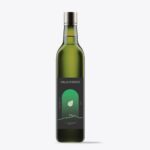
We have 859 trees and our production is small, and different every year. If you would like to taste our new oil, read our story on the About us page or write to us at info@vallederice.it: we ship across the European Union.